
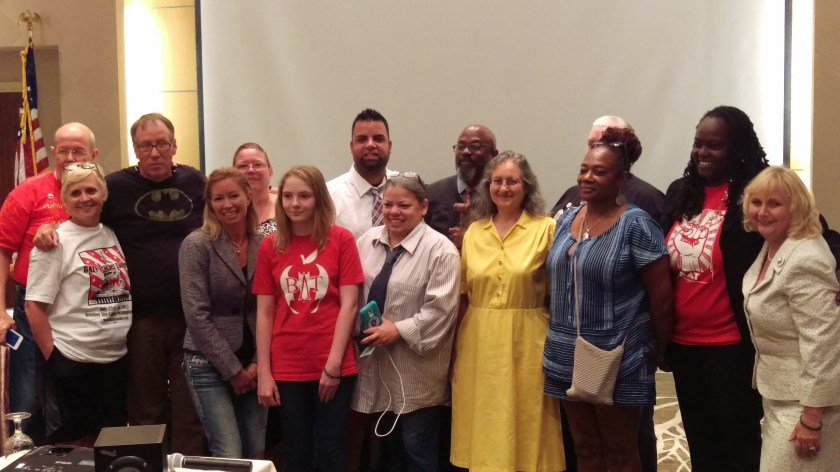
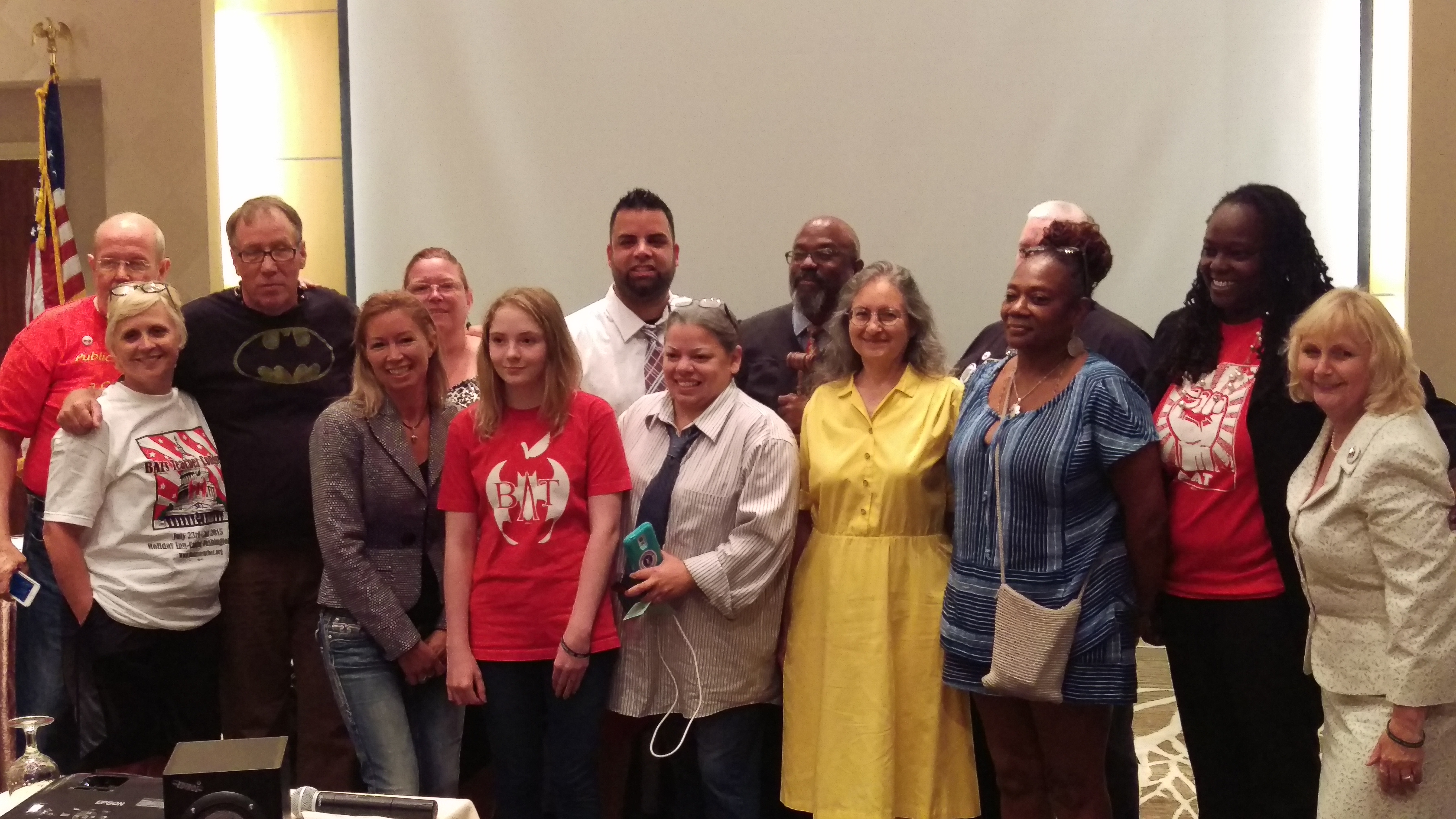
The recent education Mock Trial had everything from court outbursts, gavel smashes, to witness badgering. The trial was a lot of fun but still had an underlying seriousness due to the subject matter. Conducted just a few yards away from the U.S. Department of Education, the event was organized by Save Our Schools March in conjunction with the BadAss Teachers Congress on July 24. (full video below)
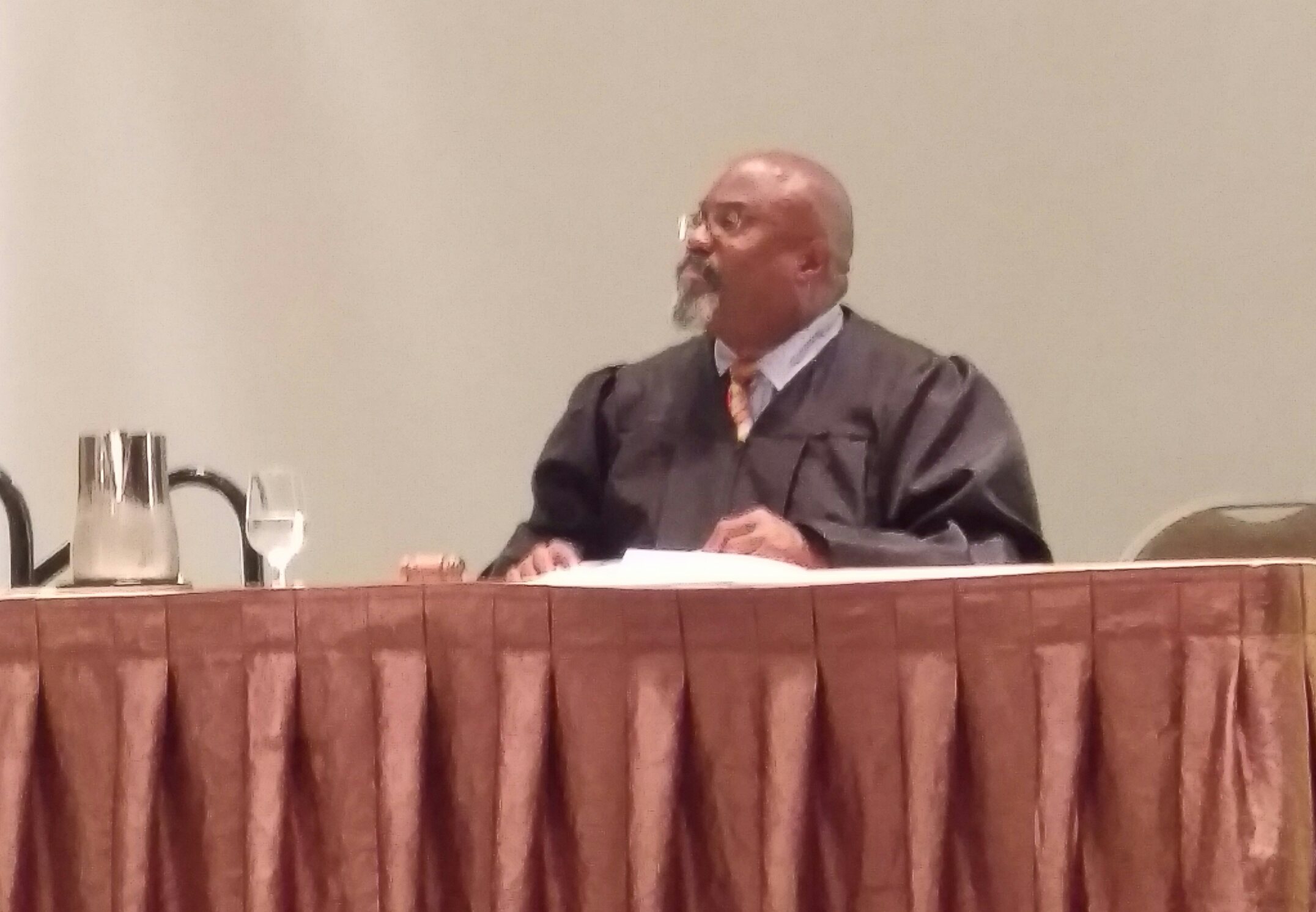 The case put Eli Broad, Arne Duncan, Rahm Emanuel, and Campbell Brown on trial for crimes that the prosecution believed were in violation of the 14th amendment and were also considered hate crimes. The case was authentic: there were witnesses, a prosecutor, a defense lawyer, and even a judge (played by our very own Thomas Byrd). The trial was mostly lighthearted but still focused on major issues.
The Mock Trial, along with all of the week’s educational advocacy activities, brought together people from all over the country that felt strongly about the issues being presented.
Kathleen Jeskey, an Oregon 6th grade teacher, believed that the Mock Trial could bring attention to the problems that teachers are facing. “People aren’t aware,” she went on state that, “we have a national problem.”
Larry Proffitt also spoke on the magnitude of the trial. Hailing from Nashville, Tennessee, Proffitt, the 7th grade science teacher and witness in the trial, said that teachers now are “filling the gap between knowledge and legislation.”
Michelle Ramey, a 2nd and 3rd grade teacher, came all the way from Seattle, Washington to attend the BAT weekend. When asked why she wanted to participate she replied, “educators have sat back,” while the law makers have “steamrolled students.”
Proffitt though, was optimistic about the trial. He confronted the common misconception of protesters by saying, “we don’t just complain. You’ll see plans of resolution.”
For the Prosecution: Teachers
 Ceresta Smith, the first witness and a teacher in Miami-Dade County, Florida, was asked many questions pertaining to the crimes committed by the accused. Smith responded to questions focused on the greed accompanying the defendants; she compared the accused to “vampires” and “bloodsuckers.” She went on to talk in detail on how a lot of money is being poured into education, but a lot of it is not reaching the teachers, “they’re trying to starve teachers out of their homes.”
The second witness, Rosalie Friend, a teacher in Brooklyn, New York, was asked similar questions, including what was at stake if the accused do not receive punishment. Her answer did not lack any honesty, and it brought a large dose of reality, “unfortunately a lot of children are losing the opportunity to learn to use their minds.”
Larry Proffitt was asked to take the stand and answer questions about tenure and how it contributes to the failing of public schools. “Number one, public schools are not failing,” he testified. “our government is what’s failing, not our schools.” Proffitt went on to offer an explanation of tenure, accusing Campbell Brown of having an agenda against the protection of teachers, which is steadily being “eroded.”
The fourth witness, Marla Kilfoyle, is the General Manager of BAT but was speaking on the behalf of parents. She was asked about standardized testing and the affect it has on children. Kilfoyle believed that high-stakes standardize testing does nothing but hurt children, schools, and entire communities. She stated that standardize testing is a tool used to, “assault our urban communities.” When asked how to improve the public school system, Kilfoyle campaigned for sustainable community schools. She believes that educators, parents, and children need to have a stronger input in the direction they want their students to go in.
A Final Witness
The fifth and final witness for the prosecution, who arguably stole the show, was 11 year-old Maurine Flanagan. While most of the witnesses were asked questions about their experiences as teachers, Flanagan gave an interesting perspective on the mistreatment of teachers, from the eyes of a student. She detailed how her favorite teachers get shipped off to private or charter schools and replaced frequently.
“We don’t need to find new teachers, we need to keep the good ones.” Flanagan, who once attended a charter school, testified. She also gave insight on how students view them, “test, test, test,” she said, going on to express that test scores could jeopardize your time at the school.
“I am more than my score,” Flanagan concluded. She easily was awarded the most boisterous applause, and essentially won the case.
Defense and Conclusion
The real fun was watching the accused “try” to defend themselves. Eli Broad was played by Aixa Rodriguez; Jesse Turner took the role of Arne Duncan; Rahm Emanuel was portrayed by Gus Morales; and finally, Morna McDermott played the role of Campbell Brown. The character portrayals were quirky. The mannerisms matched the characters and words said from the defense were borderline outlandish, but were still believable and sometimes actual quotes. From “Arne Duncan” repetitively proclaiming how much he “loves teachers,” to Rahm Emanuel using his friendship with President Obama as protection, even to Eli Broad throwing money in the air, the highly competent professionals resembled more fools than officials.
Though many outburst and breaks for laughter and applause, the trial was still treated as if it were a real case. After all of the testimonies, the judge, who was “disgusted” with the defense, ruled in favor of the prosecution and found the defendants guilty.
The Mock Trial was a great performance and brought through a very strong message. The trial was filled with aspects of comedy but Denisha Jones, who played the role of the prosecuting attorney, believed there was still, “a lot of truth to it.” Jones hoped that the Mock Trial would “inspire other people” to support the cause or even host a trial of their own. When asked how the final product stacked up to her expectations, Jones said she felt, “accomplished,” not simply for finishing, but for showcasing a major problem in a major way.
Full Video Here —
 Education Town Hall Forum